Musical Box: Where Vintage Brass Meets Modern Digital Type
There’s a distinct feeling you get when you encounter something crafted with genuine care, something that carries the weight of history in its design. It’s a sense of quality, of character, of a story waiting to be told. In the world of typography, finding a font that captures this feeling is like discovering a hidden treasure. That’s precisely the experience of working with Musical Box, a typeface that doesn’t just spell words but evokes an entire era of craftsmanship and industrial elegance.
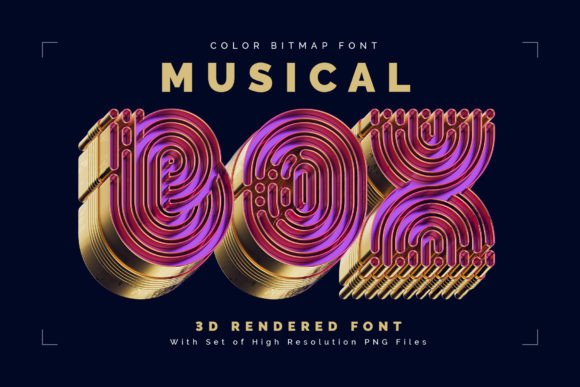
Imagine the polished brass of a vintage gramophone, the intricate filigree on an old music box, the sturdy, functional beauty of early 20th-century equipment. Musical Box translates that aesthetic into a complete set of letterforms. This isn't a simple sketch or a flat vector; it's a 3D-rendered, high-quality typeface built as a color bitmap OpenType-SVG font. What does that mean for you? It means every character has authentic depth, texture, and a tangible, metallic presence right out of the box. The shading, the highlights, the subtle patina—it’s all baked in, offering a level of realism that traditional fonts simply can't achieve.
More Than a Font: A Complete Design Asset
The true power of a creative font like Musical Box lies in its versatility as a design asset. While it functions as a standard OTF font, the included set of full-resolution PNG files with transparent backgrounds opens up a world of possibilities. These aren't low-quality thumbnails; we're talking about average resolutions of 10 megapixels. This means you can scale these characters for large-format printing, intricate craft projects, or high-DPI digital displays without a single pixel of quality loss. For a designer, entrepreneur, or crafter, this is invaluable. You’re not just getting a typeface; you’re getting a library of high-fidelity graphic elements.
So, where does a premium font like this truly shine? Its bold, dimensional nature makes it a standout display font. Think of it as the star of the show, not a background player. It’s perfect for:
- Logo Design & Brand Identity: For a brand that wants to project heritage, craftsmanship, or a steampunk-inspired aesthetic, Musical Box is an instant identifier. It can form the cornerstone of a memorable logo for a craft brewery, a bespoke tailor, a vintage restoration shop, or a podcast about history.
- Editorial & Packaging Design: Use it for pull quotes, chapter titles, or product names on packaging. It adds a tactile, high-end feel to magazines, book covers, and product labels that demands attention.
- Web & Social Media Graphics: In a sea of clean sans serif and minimalist modern typography, Musical Box stops the scroll. It’s fantastic for hero text on a website, promotional banners, or creating standout quotes for Instagram and Pinterest.
- Personal & Commercial Projects: From wedding invitations with a vintage theme to custom apparel, greeting cards, and physical signage, its applications are nearly endless for anyone with a creative vision.
Practical Guidance for Working with Musical Box
Integrating a powerful typeface like this into your workflow requires a thoughtful approach. It’s a tool with a strong personality, and using it effectively means understanding its strengths and nuances.
First, a note on technology. As an OpenType-SVG color font, Musical Box relies on newer technology. While it has broad support in popular applications like Adobe Photoshop, Illustrator, InDesign, Procreate, and Affinity Designer, it’s wise to check its compatibility with your specific software version. This isn't a limitation but a feature of its advanced rendering. Always test it within your project environment before finalizing a design.
When it comes to font pairing, the goal is balance. Musical Box is a commanding presence. Pairing it with another ornate or complex font would create visual chaos. Instead, let it breathe by combining it with a clean, neutral companion. A simple, geometric sans serif font for body text is a classic choice that provides a clean canvas for Musical Box to perform. A straightforward, readable serif font can also work beautifully, creating a cohesive, vintage-inspired hierarchy. The key is contrast and clarity.
Readability is another critical consideration. Due to its detailed, textured nature, Musical Box is not designed for long blocks of body copy. Its strength is in headlines, titles, logos, and short, impactful phrases where its intricate details can be fully appreciated. For any text that needs to be read quickly and easily at smaller sizes, always opt for a simpler typeface for the main content. This practice of using a decorative font for headlines and a legible one for body text is a fundamental principle of good web design and editorial design.
Finally, consider the project’s context. Does the vintage, industrial character of Musical Box align with your brand’s voice? For a tech startup, it might feel out of place. But for a distillery, an artisanal cheese maker, or a music producer specializing in classic sounds, it could be the perfect visual metaphor. Evaluate its personality against your brand identity to ensure it enhances, rather than confuses, your message. By thoughtfully selecting where and how to use this remarkable commercial font, you can leverage its unique character to create designs that are not only beautiful but also strategically effective, leaving a lasting impression on your audience.